
If you're considering building a mental health or wellness product, you've identified one of the most promising markets in tech today. The global AI in healthcare market is racing toward $164 billion by 2030, with mental wellness tech leading the charge.
Your potential users are actively seeking solutions that meet them where they are: on their phones, between meetings, during those quiet moments when anxiety hits at 2 AM. The pandemic accelerated this demand — BetterHelp saw a 95% user spike that continues today. Traditional therapy sessions cost $150-200, while your AI-powered alternative can deliver support for $30-40 while being available 24/7.
The opportunity is massive, and the timing is perfect. Companies that understand both the technical complexity and user psychology are building sustainable competitive advantages in this rapidly growing space.
The investment climate has never been better
Investment in mental health AI is at an all-time high, creating unprecedented opportunities for innovative products.
Government funding is at record highs. The U.S. SAMHSA budget hit $8.1 billion in 2025 — an unprecedented level focused on digital mental health infrastructure. States like Illinois are offering dedicated innovation grants specifically for digital mental health solutions, making it easier for new products to get funded and tested.
Corporate adoption is accelerating. Employers now consider AI wellness tools essential benefits because productivity and retention depend on them. Insurance providers are documenting significant savings — up to $380 per user annually — when they cover AI-powered preventive mental health tools.
Market expansion is rapid. The AI in mental health market is expanding from $1.8B in 2025 to nearly $12B by 2034 — a compound annual growth rate of 24-25%. North America holds over 40% of the global market, with some segments like chatbots and virtual therapy tools growing up to 30% annually.
Why great technology alone won't guarantee success
Having the most advanced AI model is just the starting point. Success requires understanding how to make that technology genuinely helpful for people in vulnerable moments.
The products that succeed combine sophisticated technology with deep understanding of human behavior, seamless user experience, and rock-solid compliance architecture built from day one. Your users need to trust that your product understands both their emotional state and their practical constraints.
They will abandon even the smartest AI if the interface feels clinical, if privacy feels questionable, or if the tool doesn't fit naturally into their daily routine. Most well-funded startups in this space fail not because their technology is weak, but because they miss the human elements that make mental health tools actually work in real life.
Three critical mistakes that sink promising projects
Successful teams in this space navigate specific challenges that can derail even well-funded projects. Here are the most common obstacles we help clients avoid.
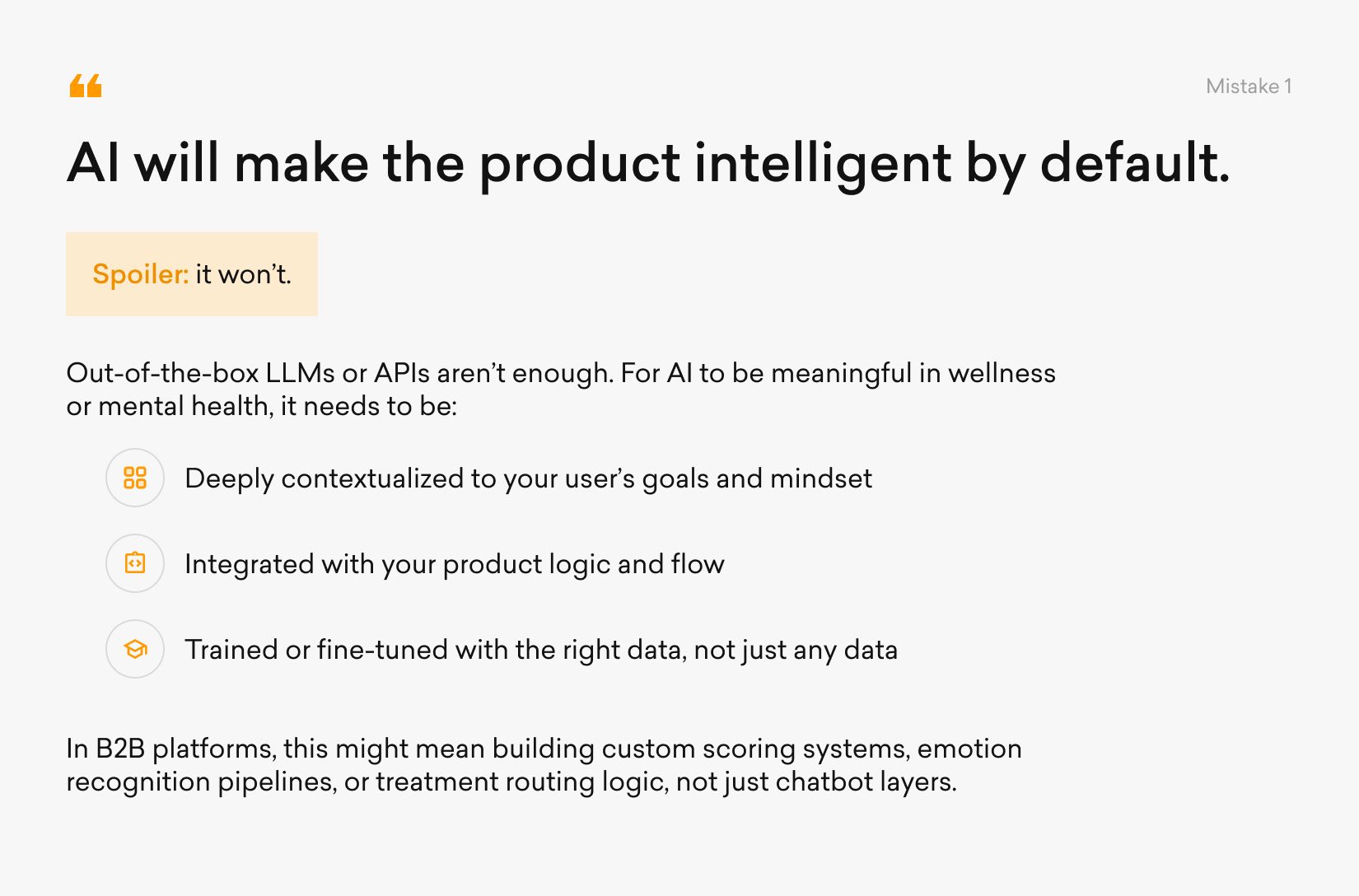
Mistake 1: Assuming AI will automatically be intelligent for mental health contexts.
Out-of-the-box LLMs or APIs aren't enough. For AI to be meaningful in wellness or mental health, it needs to be deeply contextualized to your user's goals and mindset, integrated with your product logic and flow, and trained or fine-tuned with the right data, not just any data. In B2B platforms, this might mean building custom scoring systems, emotion recognition pipelines, or treatment routing logic, not just chatbot layers.
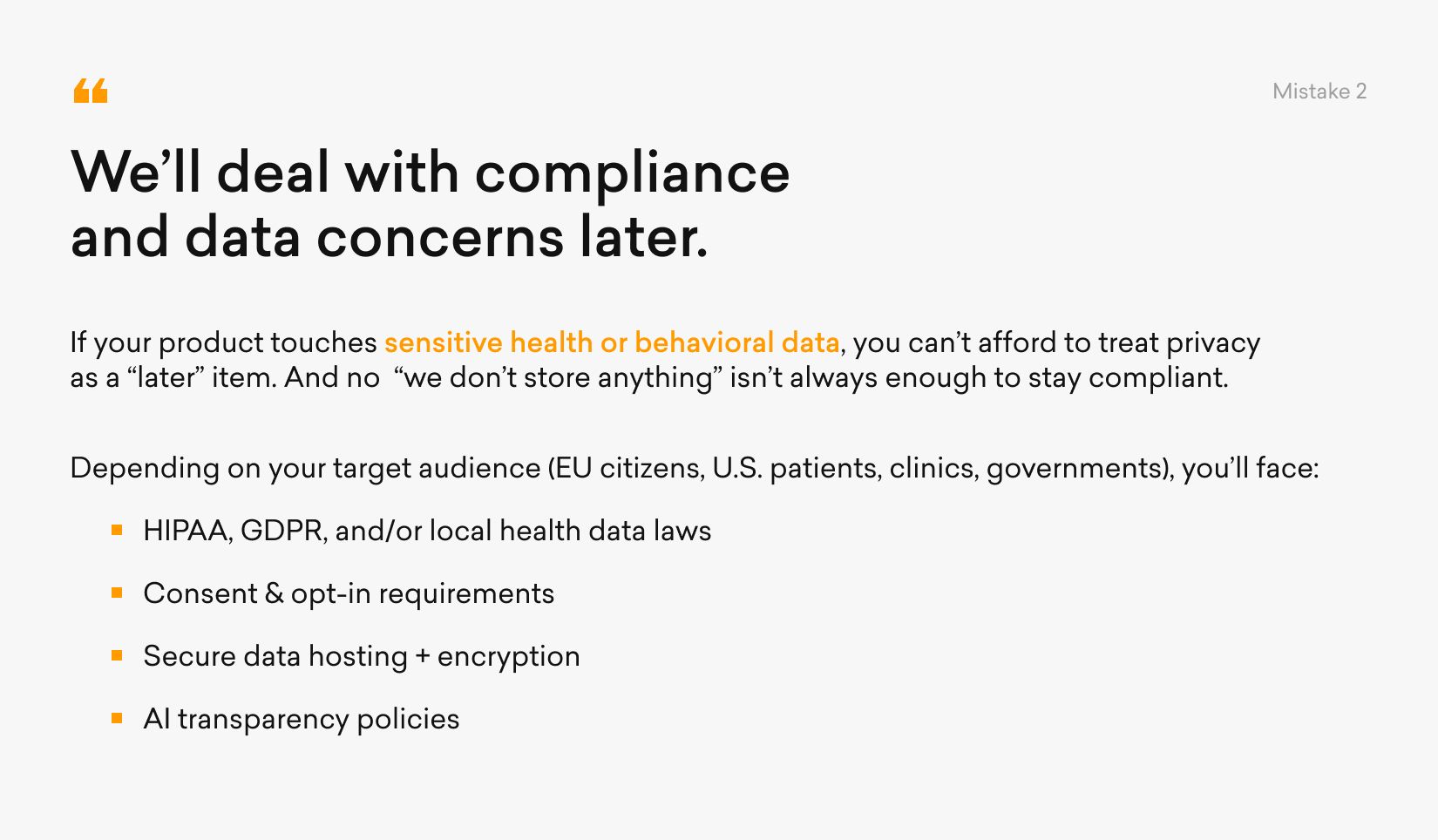
Mistake 2: Treating compliance and privacy as later considerations.
If your product touches sensitive health or behavioral data, you can't afford to treat privacy as a "later" item. Depending on your target audience (EU citizens, U.S. patients, clinics, governments), you'll face HIPAA, GDPR, and/or local health data laws, consent and opt-in requirements, secure data hosting with encryption, and AI transparency policies. And no, "we don't store anything" isn't always enough to stay compliant.
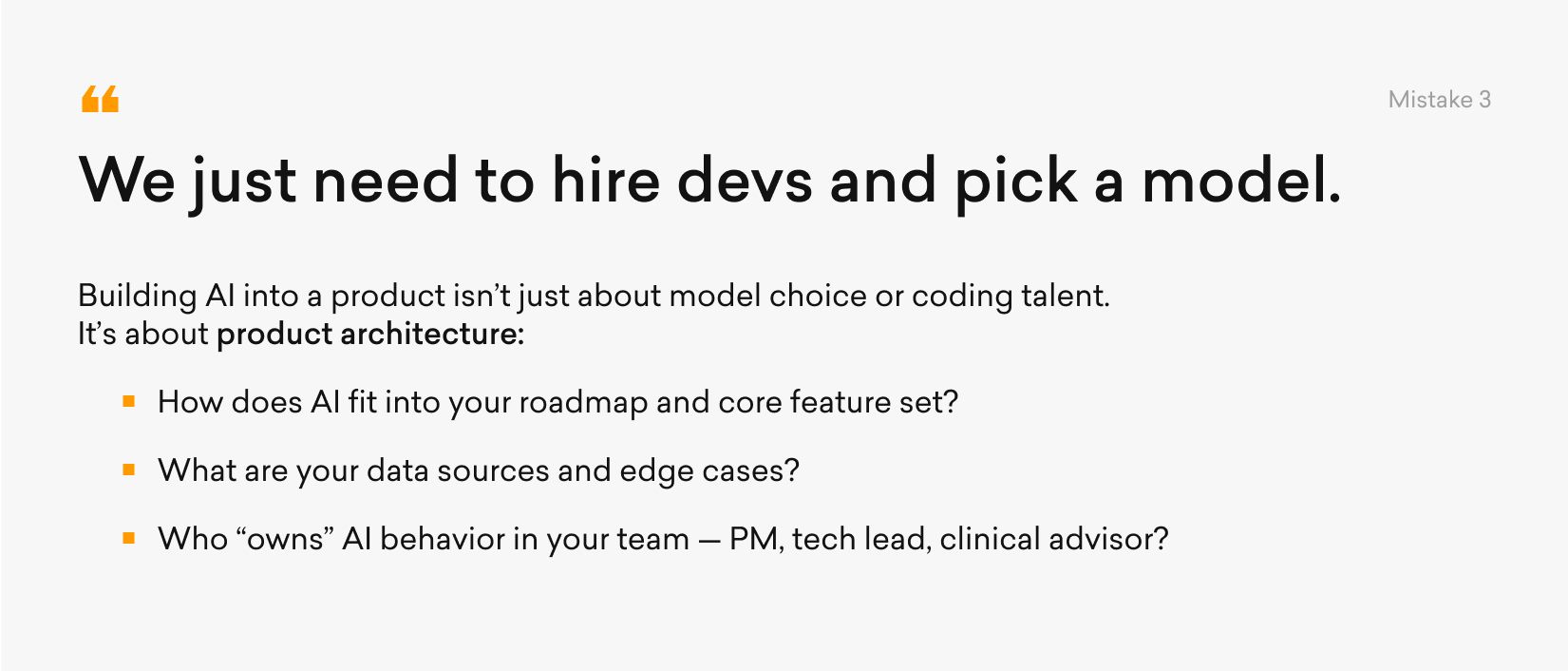
Mistake 3: Underestimating the multidisciplinary nature of mental health products.
Building AI into a product isn't just about model choice or coding talent. It's about product architecture: How does AI fit into your roadmap and core feature set? What are your data sources and edge cases? Who "owns" AI behavior in your team — PM, tech lead, clinical advisor?
Lessons from building our own products
We've developed our expertise through building our own AI-powered mental wellness products, giving us hands-on insight into the unique challenges of this space.
CalmPal: our foundation in AI mental health
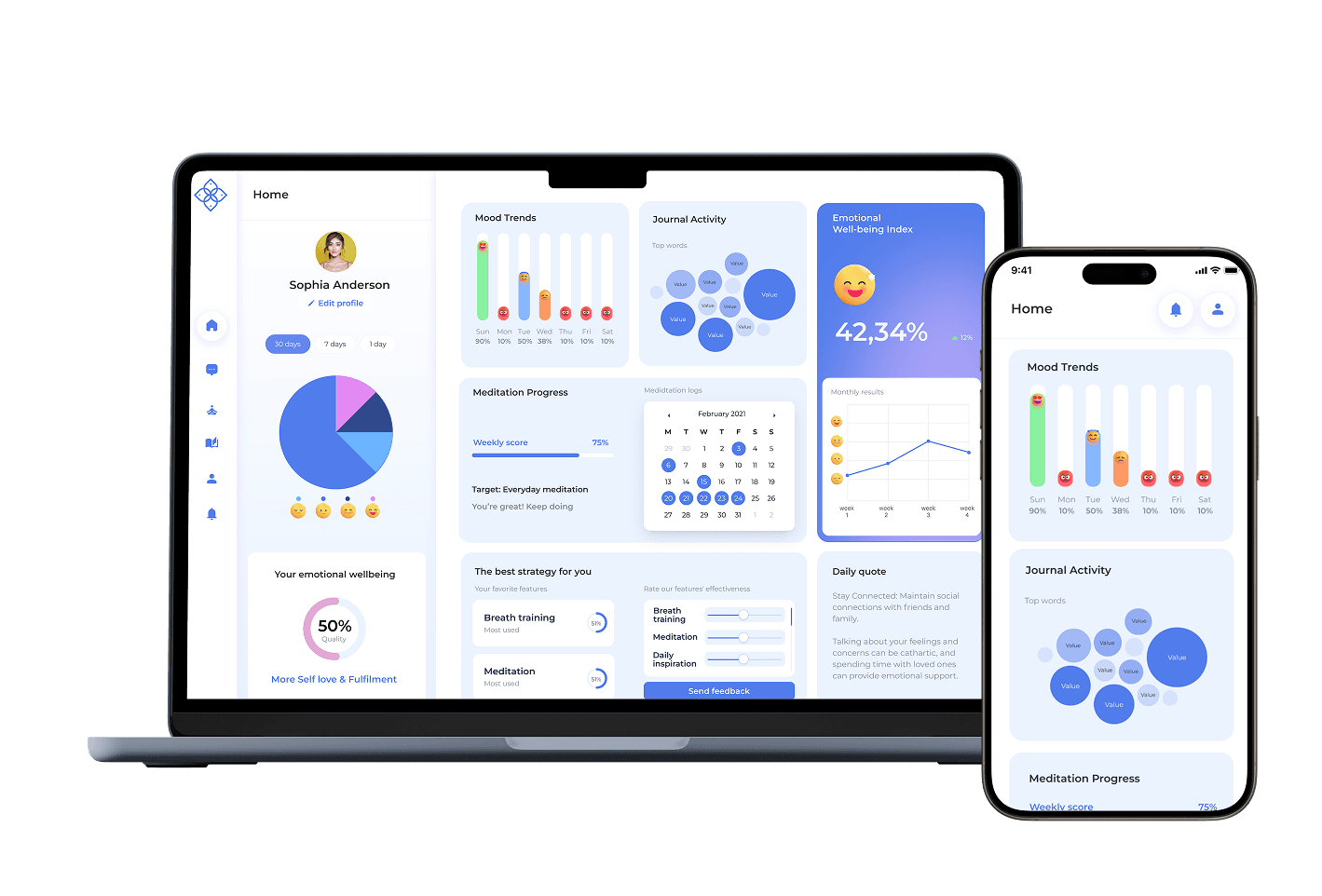
In 2023, we created CalmPal as our first independently built AI-powered mental health app. This focused MVP helped us test and deepen our expertise in emotional wellness and conversational AI.
The app combined several key features:
A responsive AI chatbot for emotional check-ins
Mood tracking and quick journaling tools
Mindfulness modules designed to support daily emotional regulation
We led the full early-stage cycle from product discovery and UX design to a functional prototype with a clear goal: to validate the user experience and understand the role AI could play in real-time mental health support.
Though CalmPal never went public, it laid the foundation for our future wellness products. It also gave us practical insight into how people interact with AI-driven emotional tools—insight we now bring to client projects.
 While CalmPal marked our first attempt at building in this space, our broader journey in healthcare and wellness actually began much earlier — in 2017 — through long-term partnerships like SnapCare, a major healthcare platform we continue to support.
Heiwa: advanced CBT-based AI for emotional reframing
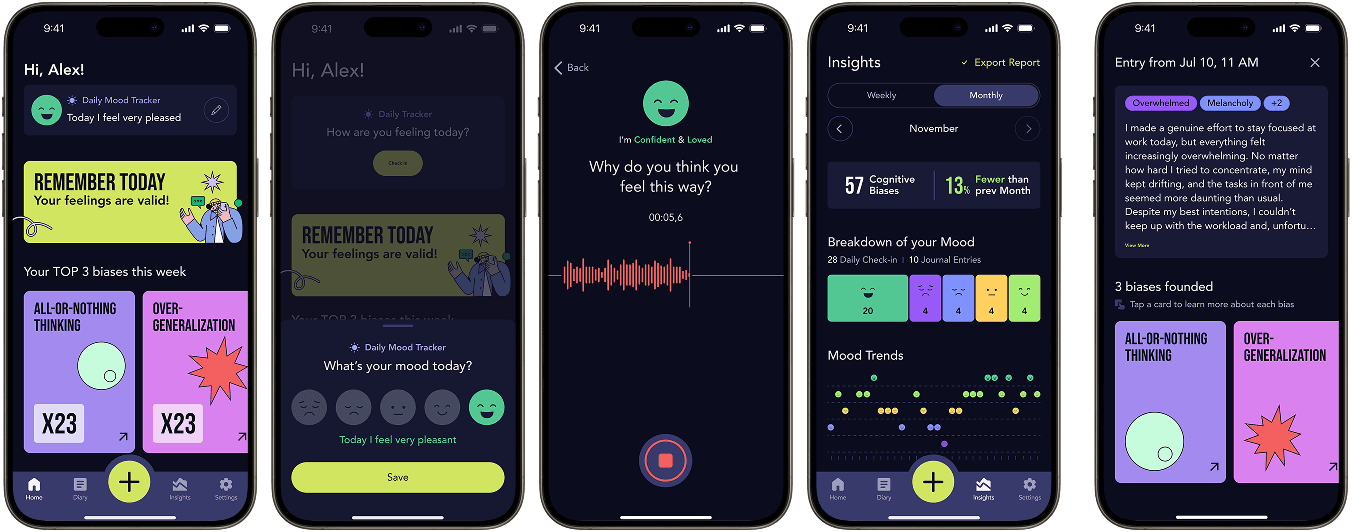
Heiwa is our in-house wellness product, designed to help users process their emotions and reframe negative thinking through the lens of cognitive behavioral therapy (CBT).
The app allows users to log their mood and thoughts via voice or text, which are then transcribed, analyzed, and categorized by AI based on a set of 19 clinically established cognitive distortions (e.g. catastrophizing, black-and-white thinking).
We started with in-depth interviews with CBT therapists, built a proprietary cognitive analysis engine, and designed the UX around real therapy workflows, making it useful both for self-guided reflection and between-session tracking.
Key features:
Multilingual voice-to-text journaling
AI-powered detection of cognitive distortions
Personalized insights based on user entries
Downloadable reports for therapy sessions
Full-cycle developed by our team in just under 5 months — from product research and UX design to development, testing, and go-to-market strategy.
We've marketed Heiwa both as a B2C tool for individuals and as a B2B solution for therapists, who now use the app to complement their clinical work with clients. Therapists love the structured insights and clients love the simplicity — it's therapy support that fits between the sessions.
Why execution determines success in this market
With the market opportunity established and demand proven, the critical question becomes: why do some AI mental health products succeed while others fail?
The reality is harsh: most products fail at execution, not technology. Many AI mental health products fail, not because the tech doesn't work, but because the product doesn't land. Poor UX, vague positioning, or lack of real user research often break things before they ever scale.
Success requires getting the fundamentals right. Products that thrive are user-first, not feature-first; built with HIPAA/GDPR-ready architecture from day one; and deeply contextualized, not just chatbots plugged into APIs. They're backed by real insight into behavior, emotion, and therapy-adjacent logic.
The companies getting execution right are already seeing results. AI helps cut admin time by up to 50% for healthcare providers. One in four therapists already use AI in their workflows, and two-thirds of psychiatrists rely on it to lighten administrative load.
The window for competitive advantage is now. The companies who master both the technical complexity and human psychology of mental health AI today will be the ones leading this market tomorrow.
Let's build something together
Over the years at Binary Studio, we’ve helped early-stage startups, scaling SaaS platforms, and healthcare innovators turn ideas into powerful tools.
Our expertise includes:
Full-cycle development of AI-powered mental health and wellness apps
Deep knowledge of User Experience, and behavioral design and research
Building HIPAA-compliant, high-scale healthcare platforms from MVP to enterprise
Real AI integration: NLP, personalization engines, and more
We work with products end-to-end — from early research and UX design to scalable, production-ready systems.
Whether you're building your first MVP, expanding your existing solution, or exploring how AI can fit into your product — we’re here to make it faster and avoid costly detours along the way. Let’s talk about how we can help you build a product that’s technically solid, user-centered, and ready to grow.